Folio 13b
When the Moon is in conjunction with the Sun and is also at one of the points of the head and the tail (the nodes), or near one, it passes under the Sun's rays and comes between our sight and the light.
When the Moon is between the Sun and our sight, if the Moon had no latitude from the sphere of the signs, its body would fall in the very middle of the cone (reaching our eye) from the Sun. To the extent the latitude requires, part of the Sun is then eclipsed; if (the covering) is greater, it is eclipsed entirely.*1
When the Sun is eclipsed, its eclipse does not pause or last; at once it begins to clear from one side.
The extent of the eclipse depends, as regards the line of sight, on the differing positions of the inhabited places; that is why in some lands no eclipse occurs at all.
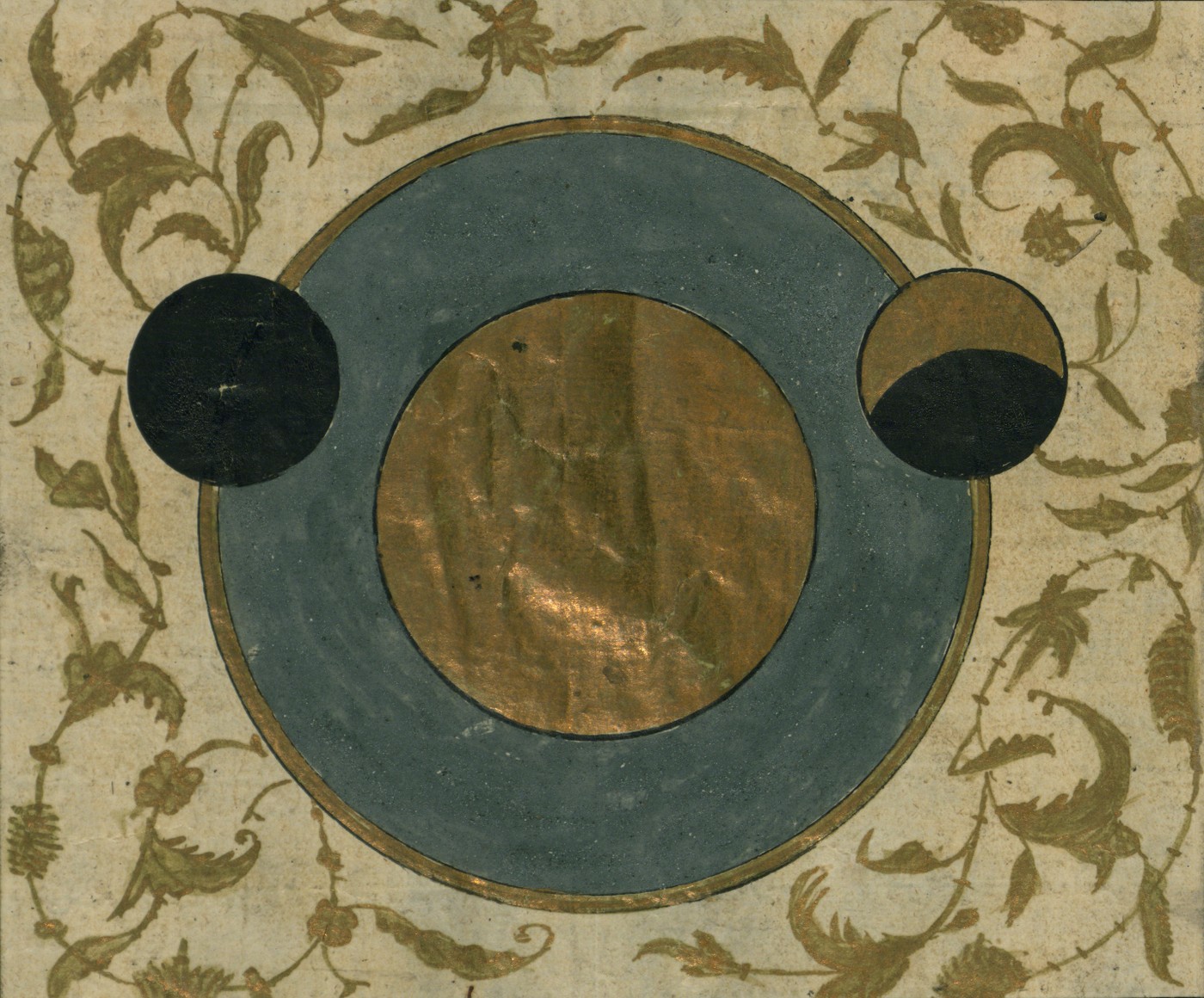
And this is the picture of its eclipse.
Section on the properties of the Sun. The Sun has an influence on the higher world: it bestows light on all the stars and on the Moon. It also has an influence on the lower world.
One of these is that when the Sun shines upon the sea, vapour forms and rises into the air. When the vapour reaches the cold air, it thickens from the cold and becomes cloud. Then the winds drive the clouds to places far from the sea…
continues on fol. 150a…and its taste is like the taste of turnip.* Needs human approval · 1
- *1line 4
عرض ایجاب ایتدوكی قدر ۞ اول زمان بعضیسی منكسف اولور ۞ زیاده اولسه تمام منكسف اولورBELİRSİZ (anlam). Okuma net, ama cümlenin mantığı kısa: 'enlemin gerektirdiği kadar ... bir kısmı tutulur; ziyâde olsa tamamen tutulur'. 'ziyâde'nin öznesi yazılmamış: Ay'ın Güneş'i örtme payı mı (tam tutulma) yoksa enlemin fazlalığı mı (o zaman tutulma olmamalı) belirsiz. Düzyazıda '(örtme) fazla olursa' diye bağlamdan tamamlandı; Arapça asılla (Kazvînî) karşılaştırılmalı. L2-L4'teki 'Şemsden vasat-ı mahrût' (Güneş'ten gelen koninin ortası) da aynı nedenle '(gözümüze uzanan)' eklemesiyle çevrildi.
Resolved or approved · 12
- resolvedline 1
قچنother readings:قحنÇÖZÜLDÜ. İkinci harf noktasız ح biçiminde; müstensih چ'yi çoğu yerde noktasız yazıyor. Önceki varaklardaki (12b, 10a) gibi 'قچن' (kaçan, ne zaman) yazıldı; L5 ve L10'da aynı kelime aynı biçimde. - resolvedline 1
رأس و ذنبÇÖZÜLDÜ. 'Re's ve zeneb' Ay yörüngesinin düğüm noktaları (baş ve kuyruk, yükselen ve inen düğüm). Elif üzerinde hemze işareti açık. Tutulmanın düğümde ya da yakınında olması koşulu astronomik olarak doğru. - resolvedline 2
اولوبother readings:اولورÇÖZÜLDÜ. Büyütmede son harfin altında tek nokta açık: ب. 'dâhil olub ... hâil olur' yapısı dilbilgisel olarak da doğru. - resolvedline 4
ایتدوكیother readings:اتیدوكیÇÖZÜLDÜ. Elifin ardından dişlerin sırası ve noktaları sıkışık; 'îcâb itdügi kadar' (gerektirdiği kadar) kalıbı tek anlamlı okuma. - resolvedline 6
بشلرother readings:باشلرÇÖZÜLDÜ. Elifsiz yazılmış; 'başlar' (incilâya başlar, açılmaya başlar). Diplomatik olarak elifsiz bırakıldı. - resolvedline 6
خسوفكother readings:كسوفكÇÖZÜLDÜ. Harf açıkça خ (üstte nokta); terim olarak 'husûf' Ay tutulması, ama bağlam Güneş tutulması (L5 'küsûfı', L7 'küsûf'). Müstensih ya da mütercim burada husûf'u genel 'tutulma' anlamında kullanmış; diplomatik olarak 'خسوفك' bırakıldı, çeviride 'tutulma'. - resolvedline 7
ولایتدهother readings:ولاتیدهÇÖZÜLDÜ. Dişler sıkışık (l-a-y-t-d-h); 'ba'zı vilâyetde' (bazı memlekette) bağlamla tek okuma. - resolvedline 9
و قمره نوربخشother readings:و قمر نوربخش,و قمره نور بخشÇÖZÜLDÜ (anlam). 'قمر'ın sonu ile 'نور'un başı bir mürekkep/kir lekesi altında; ق noktaları, م düğümü, lekenin üstünde ن noktası ve dikey bir sap seçiliyor, 'بخش' (ب altında nokta, ش üç nokta) net. 'nûr-bahş ider' (ışık bağışlar) anlamı kesin; yalnız 'Kamer'den sonra yönelme eki ه'nin bulunup bulunmadığı görülemiyor, anlamı etkilemiyor. - resolvedline 11
جوهother readings:جوّهÇÖZÜLDÜ. 'cevve 'urûc ider' (havaya, gökyüzüne yükselir); ج altında nokta, و üzerinde şedde izi. - resolvedline 12
یللرother readings:ییللرÇÖZÜLDÜ. Dişler ve لل üzerinde şedde benzeri işaret; 'yeller' (rüzgârlar), bulutları süren özne olarak bağlama tek uyan okuma. - resolvedline 12
یرلرهother readings:یركرهÇÖZÜLDÜ. Son kelimede ل'nin üstündeki eğik çizgi harekeye ait (ك keşidesi değil); ilk harfin altında nokta (ي). 'deryâdan ba'îd olan yerlere' (denizden uzak yerlere). 13a'da aynı kelime 'برلر' yazılmıştı; burada nokta altta tek, ي. - resolvedline 13
التوبother readings:ایلتوبÇÖZÜLDÜ. Reddade: elif-lam, noktalı diş, و, altı noktalı ب; elifin altında kesre benzeri işaret. 14a'nın ilk kelimesi 'ایلتوب' (iletüb) ile karşılaştırıldı, eşleşiyor; bulutları denizden uzak yerlere 'iletip' cümlesi 14a'da sürüyor.