Folio 9a
The Moon's place is the lowest heaven. Its own colour tends towards black; it takes its light from the Sun.
In each sign of the zodiac it stays two days and a third of a day. In one month it goes round the whole sphere that the Sun goes round in a year.
It is the smallest of all the planets, and in speed and motion the fastest of them all; for this reason they call it Fath al-nujum(?).*1
It has twenty-eight stations, and each night it reaches one station. If the month is twenty-nine days, it is not seen on the twenty-eighth night; if thirty, it is not seen on the twenty-ninth night. On the night it is not seen it still crosses one station. After that the crescent appears opposite the Sun.*1
God Most High said: "And the Moon We have measured out in stations, until it returns like the old date-stalk" (Ya Sin 36:39). That is: by Our power and wisdom We appointed stations for the Moon; after it has gone round all the stations it returns like the old date-stalk and appears as a crescent.
The 'urjun is the stalk to which the date cluster is attached, and it is exactly like a crescent.
The Moon's size is one part of the Earth's thirty-nine and a quarter parts.
Much has been argued about the dark patch seen on its face; but no one's mind has found(?) the way (to it).*2
The side that faces the Sun always gives light. When the Moon moves away from the Sun on the eastern side and inclines towards the Earth, only the part that faces the Sun takes light, and the crescent appears. Then, as it gradually comes nearer, its light increases. When it has completed fourteen stations it turns back from there, and as it gradually grows distant its light wanes; in twenty-eight days it is again as distant as before and is hidden. God knows best.*3
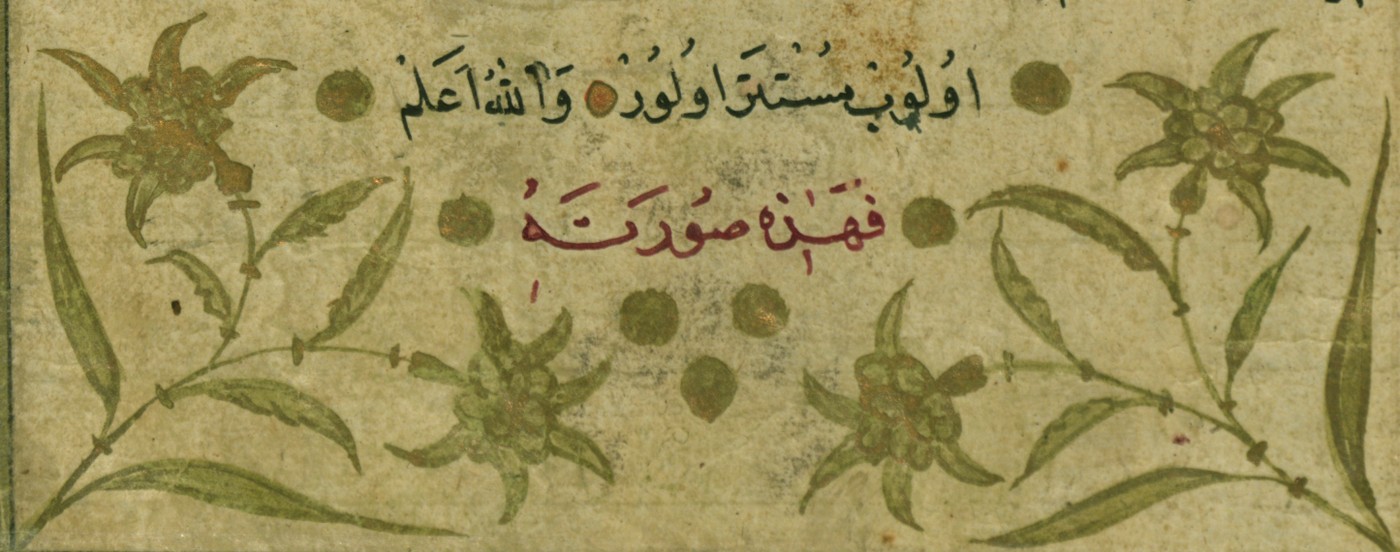
And this is its picture.*4
* Needs human approval · 4
- *1line 4
فتح النجومother readings:قتح النجومBELİRSİZ. Harfler net okunuyor (ف noktası, ت iki nokta, ح; النجوم'da ن noktası yok ama kelime belli). Ancak 'en hızlı olduğu için Fethü'n-nücûm denir' adlandırması tanıdık değil; Kazvînî'nin Arapça aslıyla karşılaştırılmalı. Çeviride ad korunup (?) ile işaretlendi. - *2line 12
اولمشدرother readings:اولمامشدرBELİRSİZ. Yazıda açıkça 'olmuşdur' (olumlu) var; ama 'çok tartışıldı, ama kimsenin aklı ...' cümlesi anlamca olumsuz bekliyor ('yol bulamamıştır'). Müstensih hatası olabilir. Diplomatik olarak olumlu bırakıldı; çeviride (?) ile. - *3line 15
قريب اولدقچهBELİRSİZ (anlam). L15 'yakın oldukça ışığı artar', L17 'uzak oldukça ışığı eksilir', L18 'önceki kadar uzak olup gizlenir' deniyor; Güneş'e göre astronomik olarak tersi beklenir. Yakınlık/uzaklık belki dolunay noktasına ya da başlangıç menziline göredir. Harfler net; okuma değil yorum sorunu. Çeviride harfiyen bırakıldı. - *4line 19
فهذه صورتهBELİRSİZ (sayfa düzeni). 'İşte bu onun suretidir' bir resim duyuruyor ama bu sayfanın altında yalnızca bitkisel bezeme var, Ay tasviri yok. Walters dizininde 'Orbit of the moon' resmi 8b'de; resim 9b'de mi, yoksa bezeme mi kastediliyor, insan bakmalı.
Resolved or approved · 2
- resolvedline 8
منازل حتی عاد كالعرجون القديمÇÖZÜLDÜ. Kırmızı yazı Yâsîn 36:39 âyetinin devamı (L7 'والقمر قدرناه' ile başlar). Müstensih 'عادك العرجون' biçiminde ayırmış; âyet metni belli olduğu için 'عاد كالعرجون' olarak verildi. - resolvedline 11
اوتوز طقوز و ربعÇÖZÜLDÜ. 'otuz dokuz ve rub' bölüğünden bir bölüğü': Ay yerin 1/39¼'ü kadar. Kazvînî'deki bilinen oranla (Batlamyus geleneği, 1/39¼) uyuşuyor; okuma net.